CASE STUDY
PRESENCE
ROLE
SOLO DESIGNER
TOOLS
FIGMA
CLAUDE CODE
AFTER EFFECTS
YEAR
2026
Presence is an ambient mobile system that notices small windows of free time and surfaces one thing worth doing with that time.
I had an observation…
How might we move beyond app-centric interaction toward experiences that adapt to human context?
Most of a day isn't on the calendar. It's spent in the gaps: waiting for a friend, walking somewhere, or the twenty minutes before dinner needs starting. This idea started from the observation that people don't lack ways to fill that time, they lack a system that notices the gap and matches it to something worth doing.
Existing iOS interactions like Live Activities, Widgets, Focus Modes, and Siri Suggestions suggest a shift away from app-centric interaction. As AI becomes more context-aware, I became interested in interactions where that philosophy becomes the primary interaction model.
Designing with some constraints…
Product Principles
Before designing any screens, I had to define how the system should behave. Calling out these principles gave the concept a foundation; a way to test every design decision against a consistent point of view.
Restraint
🔕
Interrupt only when it helps
The system only speaks up when it has something genuinely useful to say, rather than checking in out of habit or schedule.
✨
One recommendation at a time
The system offers a single suggestion rather than a list of options, so the user can decide quickly instead of weighing alternatives.
Clarity
🗣️
Explain every recommendation
Every suggestion comes with a reason behind it, so the user always understands why the system is recommending something rather than trusting it blindly.
📍
Context over navigation
The system brings relevant information to the user wherever they already are, instead of requiring them to leave their task and go looking for it.
Growth
🎯
Reward intentionality
The system is designed to encourage thoughtful, deliberate engagement rather than simply pushing the user to do more.
🌙
Learn and go quiet over time
As the system learns from the user, its recommendations get sharper and it also gets better at recognizing when a recommendation isn't warranted at all.
Product System
To make this concept behave fluidly, I broke the system down into four interconnected parts. Each system is responsible for a different layer of the experience, with its own distinct responsibility, input, and output, so that any screen or interaction could be tuned and tested independently before being evaluated as a whole.
Recommendation
The system surfaces a single, ranked suggestion paired with a clear reason why, so the user gets one confident answer instead of a list to sort through themselves.
Interruption
Before any suggestion appears, a check weighs its usefulness against the moment, so the system only surfaces when it's actually earned the interruption, not because it's due for a check-in.
Confidence
As learning accumulates, that growing sense of certainty quietly tightens how often the system interrupts and what it surfaces as recommendations.
Learning
Every time a user accepts, dismisses, or ignores a suggestion, that feedback sharpens both what the system recommends and its sense of when to recommend, if at all.

Systems map
User Flow
Mapping out the happiest path user flow provided a foundation in which to begin visualizing ideas.

Flow chart
User Impact
This project set out to make ambient AI feel transparent, controllable, and respectful of attention rather than intrusive.
✨
AI Trust
By making reasoning visible (via chips, explanations) rather than hidden inside a black box, the goal was for users to build an accurate mental model of what the AI is doing and why so trust is earned through transparency, not blind convenience.
🎮
Control of Ambient Systems
Through mechanisms like dismissing and flagging inaccurate sources, the intent was to give users real agency over the system's behavior so "ambient" never veers into "invasive," and the user always has a way to correct or push back.
😻
Comfort
Users feel that the system respects their attention and privacy, creating greater comfort with ambient AI specifically because it doesn't default to maximal engagement.
Putting pen to paper

Interaction explorations
Design Tension
With each exploration, I focused on building prototypes to quickly learn how motion could convey "ambience" and "bespoke" interactions while keeping in mind interaction patterns native to iOS. This process included asking many questions before, during, and after each iteration to serve as the foundation for aligning design decisions with product principles.
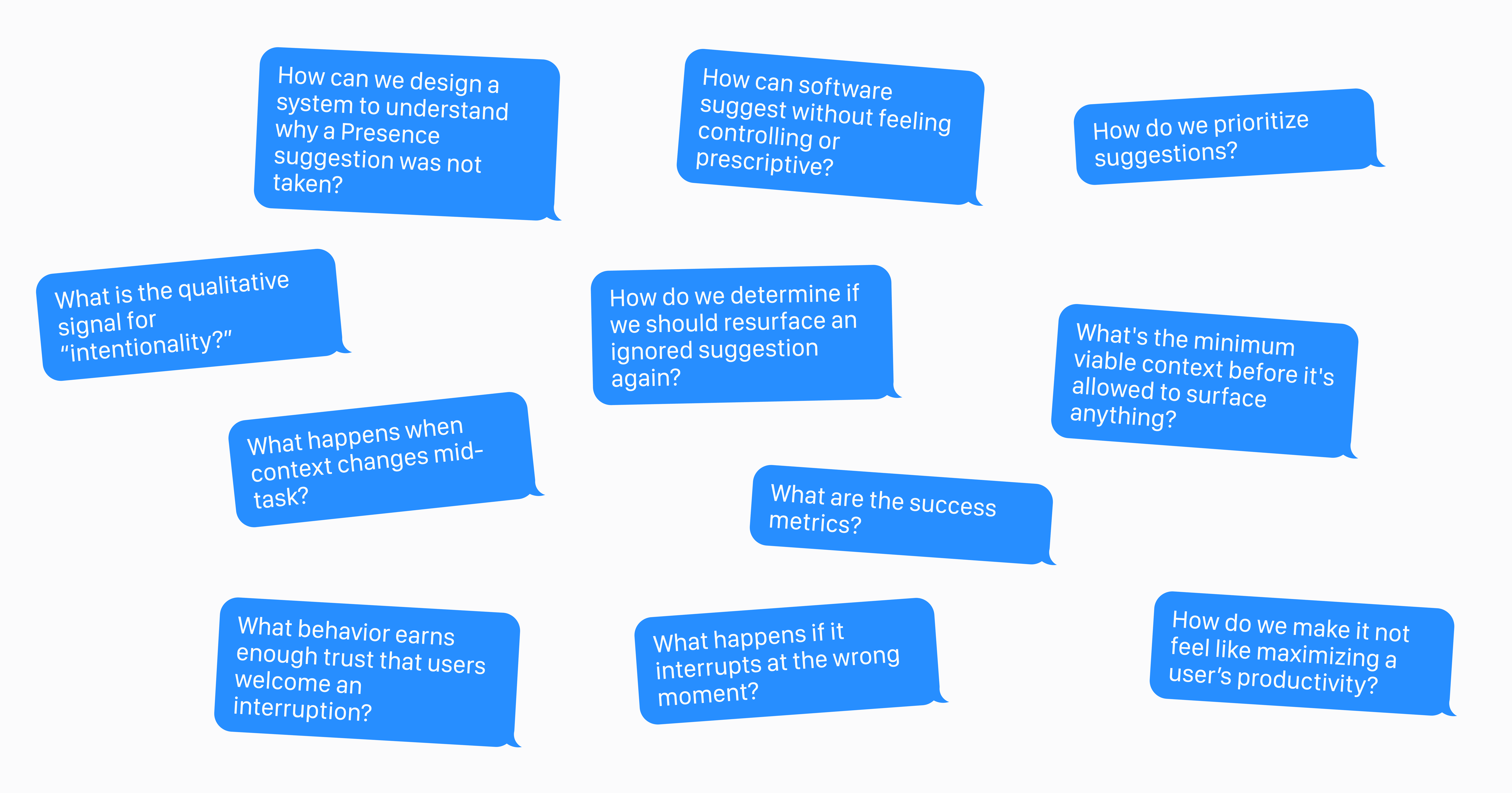
Lots of questions!
Fin
AMBIENCE
Right on time, every time
Presence makes itself know only when it's actually worth seeing, like a nudge to finish your article before your friend arrives to your coffee date.
SUGGESTION TRANSPARENCY
See the why behind every suggestion
Every suggestion opens into the context behind it, so you always know why, not just what.
BUILT ON YOUR PATTERNS
Presence remembers what matters
On your walk home, a quiet nudge to call your best friend, because you always do, and today's the kind of day you'd want to.


PROVIDING CONTEXT
The why, whenever you want it
Tap in, and see exactly what led here: three Fridays in a row, always on your walk home from work, always this same call.
