CASE STUDY
INSURANCE CASES
ROLE
PRODUCT DESIGNER
TEAM
1 PM
1 CONTENT DESIGNER
3 SWEs
TOOLS
FIGMA
CURSOR
YEAR
Q3 2025
Transforming provider credentialing into a scalable system at Mochi, accelerating patient access.

What was I responsbile for?
At Mochi Health, a direct-to-patient healthcare company, I designed an internal insurance case management tool to help administrative agents manage patient insurance workflows more efficiently and consistently.
I partnered with PM to understand operational needs and scope the product, then conducted UX research with administrative agents to uncover workflow gaps and challenges in managing insurance cases. I translated these insights into flows and prototypes, iterating with users and collaborating with a team of software engineers to refine designs, navigate technical constraints, and bring the product into production.
PROACTIVE CREDENTIALING
Stay ahead of license expirations
Expiring cases are surfaced on the dashboard to avoid credentialing delays allowing providers to practice seamlessly
SPLIT VIEWS
Effortlessly multitask without context-switching
Agents can cross-reference information across systems in real time, helping to verify details quickly, reduce context switching, and resolve tasks more efficiently.
End-to-end licensing support

Seamless multi-state licensing
What prompted us to reimagine provider credentialing?
Provider credentialing at Mochi is fragmented and slow, causing risks to revenue and patient access
Managing 400+ provider onboarding, credentialing, and insurance applications requires both precision and efficiency so that providers can meet with patients as soon as possible. However, the existing workflows—spanning spreadsheets, and dispersed dashboards—introduce inefficiencies that affect providers, operations agents, and patients.
Scattered information everywhere…
Spreadsheets and disorganized forms
Current system issues…
🧩
Fragmented
Agents had to search across multiple systems to reconstruct a provider’s verification history, slowing credentialing issue resolution.
❓
Ambiguity
Without clear task prioritization, agents struggled to identify which credentialing actions are most urgent.
📈
Scaling Limitations
Manual and inconsistent processes made it difficult for agents to efficiently manage growing credentialing volume.
What can we do?
Align on the questions that drive us.
HMW reduce cognitive load for operations agents?
HMW surface bottlenecks to avoid delays?
HMW replace ambiguity with structured transparency for providers?
HMW create an action oriented mindset to optimize agent time and energy?
Define success metrics.
Increase in # of completed applications by agent per week
Increase in # of successful applications per week
Decrease in average provider onboarding workflow time
Decrease in steps of credentialing workflow
Design principles.
Surface actionability
Make it immediately clear to agents what requires attention and what actions should be taken
Support information density
Present complex information to help agents quickly understand context and make decisions without jumping between disconnected systems
Design for scale
Create reusable components and patterns that support increasing patient and provider volume without adding operational complexity
Now, I began to iterate & build prototypes
Information Architecture
Exploring how information is organized. Some ideas validate our assumptions, while others exist to challenge them.
IA explorations
Prototyping
With each exploration, I focused on building prototypes to quickly learn how agents would effectively implement this new system into their workflow, taking feedback from users.

Interface iterations
So how did I refine and make design decisions?
How should agents focus on tasks?
I explored different ways to present cases to agents, presenting it as an expandable row or split-view. I wanted to encourage users to multitask and view a lot of information at once.

Expanded row did not take advantage of screen surface area and had too many competing elements
Split screen provided a focused interface in which to complete case tasks
How should case information be presented?
With many different types of information associated with each case, I explored presenting them in a long scrollable window and hidden behind tabs to aid in efficient case completion.

Scrolling to view information is time consuming and requires too much context switching
Viewing different types of information at once allows for a full picture of how to complete case
How do we create a robust filtering system?
Because different internal teams handle different categories of insurance cases, having an effective filtering system is essential to ensuring efficient case assignment.

Limited and unintuitive filters made sorting hundred of cases inefficient and unusable
Balance between types of filtering to refine cases and make completion more manageable
VALIDATION
I built interactive prototypes for operations agents to click through, using their feedback to identify friction, test workflows, and refine design decisions. This hands-on validation, paired with Product and Operations collaboration, helped ensure the final experience supported how agents actually worked.
Collaboration
Design System
Working closely with engineers, developed new components and interaction patterns. I defined component states, behaviors, and reusable patterns, collaborating through implementation to refine designs and ensure consistency. These additions expanded Mochi’s design system while creating a scalable foundation for future operational tools.
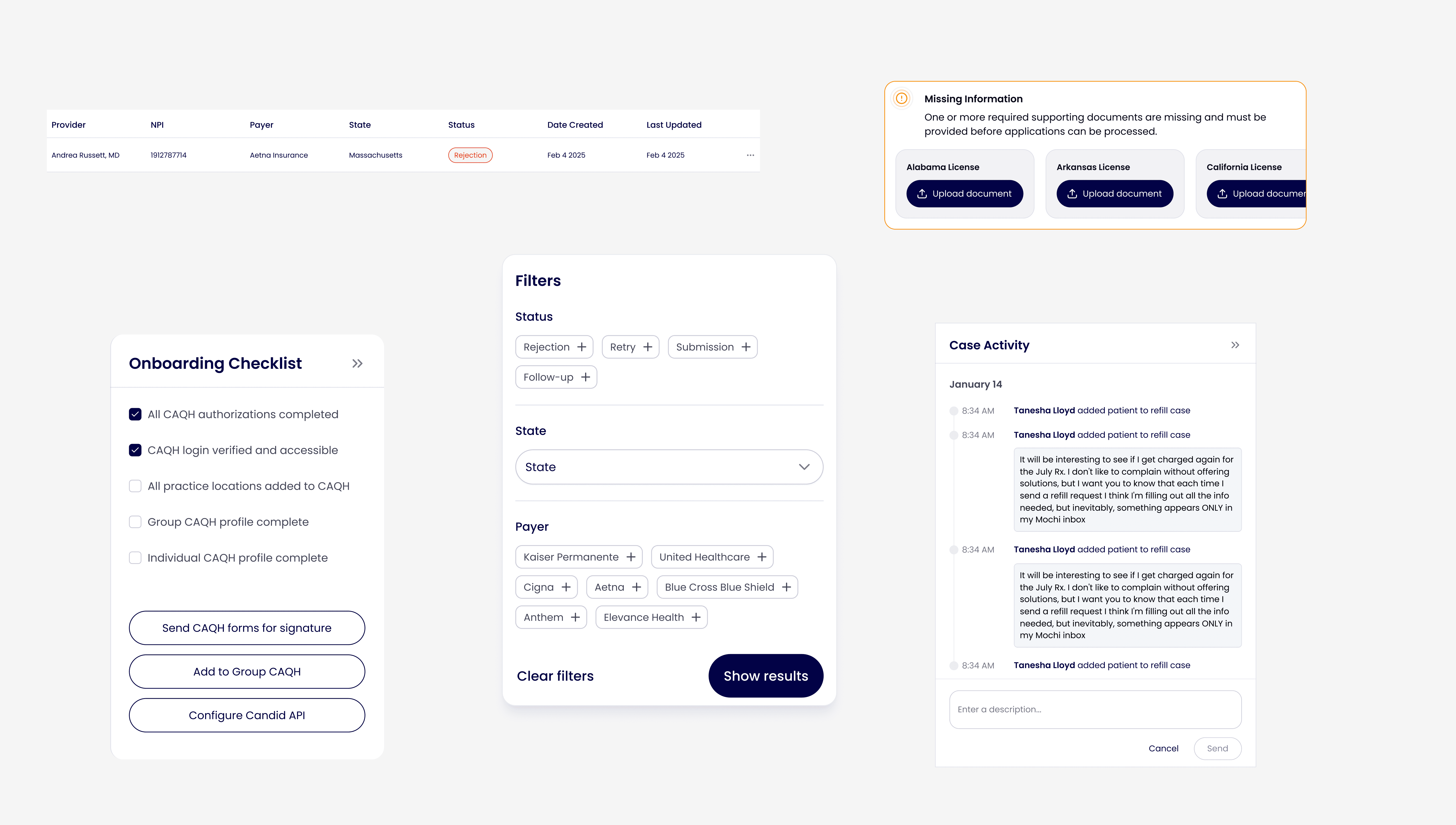
New components
Launch
Final solution graphic
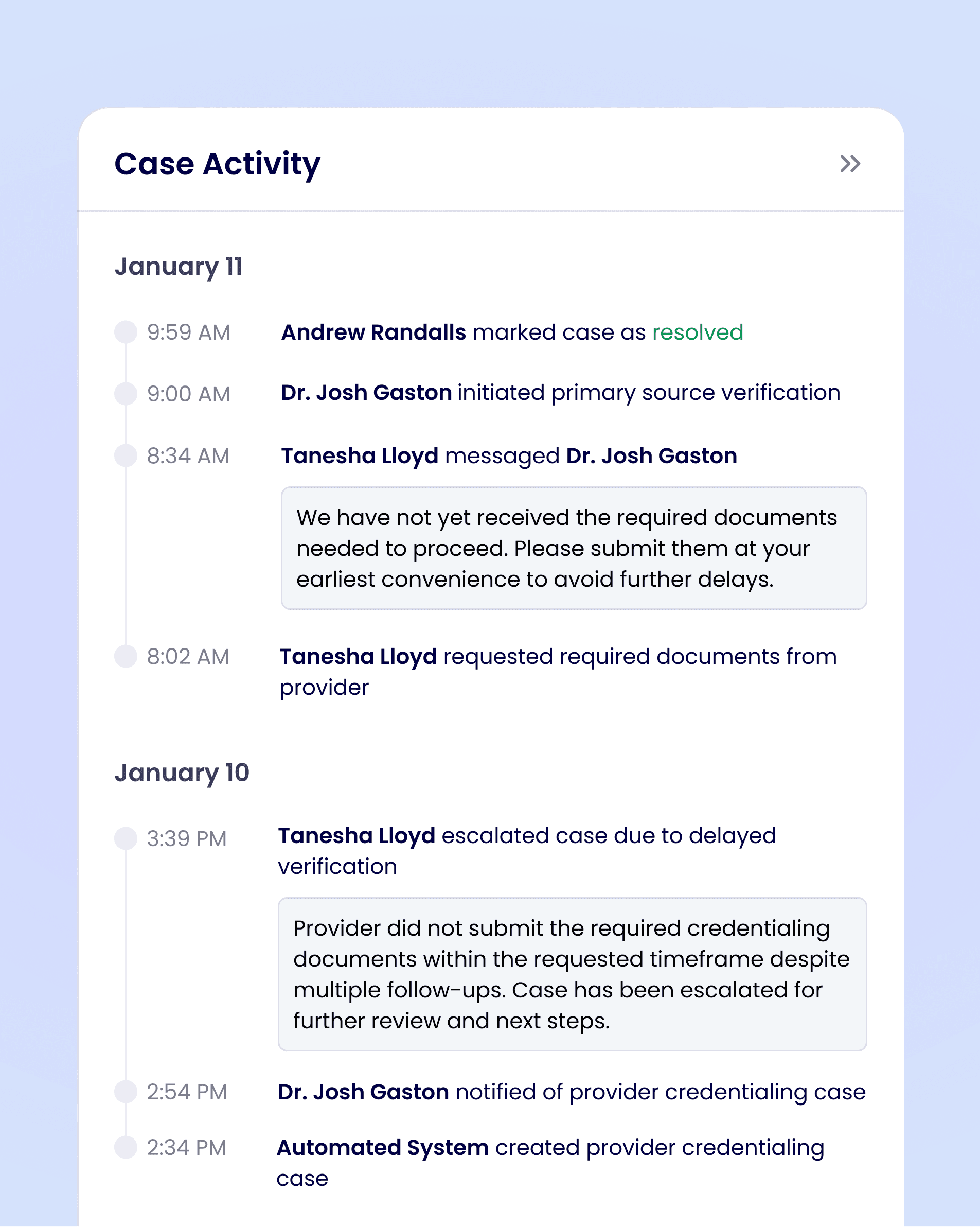
Continuity of case actions
Alerts for up to date licensing
Impact
150% increase in completed applications per agent per week
Provider onboarding time reduced by 60%
Average time spent on credentialing workflow decreased by 58%